 en
en
 pl
pl
 sv
sv
 de
de
 fr
fr
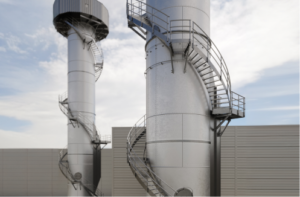
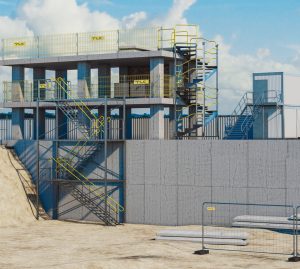
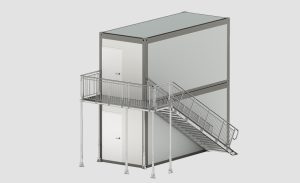

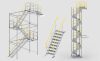

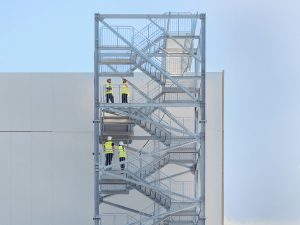
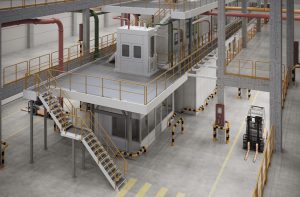
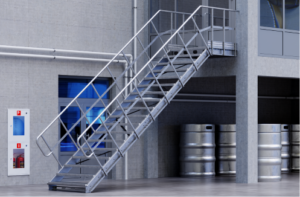
Steel stairs regulations and standards
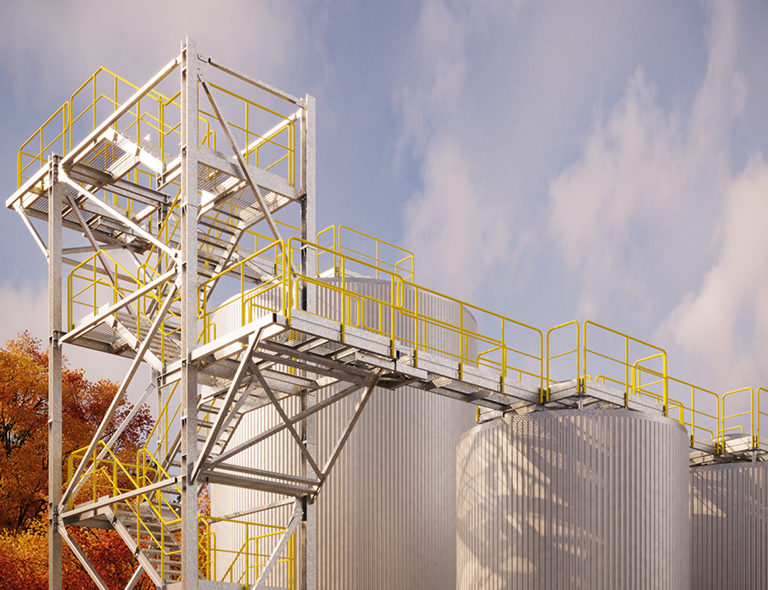
Metal staircases as construction products – legal classification and requirements
Each staircase permanently installed in a building, influencing the fulfillment of its functional properties and basic requirements, is classified as a construction product and is subject to the regulations applicable to construction products.
Construction products in every case are subject to requirements specified in sets of regulations both at the international level of the European Union and at the national level. Due to the same group of products – construction products – the principles of introducing metal stairs to the market do not fundamentally differ from other construction products. There are no separate regulations specifically for metal stairs. Only specific requirements regarding manufacturing are defined, which concern steel or aluminum load-bearing building structures.
For construction products, including steel stairs, legal requirements at the EU level are regulated by Regulation (EU) No 305/2011 of the European Parliament and of the Council of 9 March 2011 laying down harmonized conditions for the marketing of construction products and repealing Council Directive 89/106/EEC. A construction product is understood as a product referred to in Article 2(1) of the regulation. The introduction of construction products to the Polish market is regulated by the aforementioned regulation and the Act of 16 April 2004 on construction products with subsequent amendments. Additionally, the requirements are also specified by the harmonized standard EN 1090-1 (PN-EN 1090-1), which is mandatory in all EU countries.
According to EU legislation, the principle is that national regulations cannot differ from EU regulations in terms of requirements, i.e., they cannot lower the level of requirements of higher-ranking regulations, which are EU regulations. In Poland, compliance between EU and national law is accepted up to the level of the act, i.e., EU law in a given matter takes precedence only over acts.
Additionally, it is necessary to consider the requirements arising from other regulations, such as regulations concerning environmental protection, safety of use, or durability.
As it follows from the above, in order to meet all requirements, it is necessary to familiarize oneself with many documents applicable both in the EU and in the territory of the Republic of Poland. The same should be done when manufacturing a construction product intended for other national markets of EU member states.
Legal and technical regulations applicable within the EU:
Legal Acts:
- Regulation (EU) No 305/2011 of the European Parliament and of the Council of 9 March 2011 laying down harmonised conditions for the marketing of construction products and repealing Council Directive 89/106/EEC.
- Regulation (EC) No 764/2008 of the European Parliament and of the Council of 9 July 2008 laying down procedures relating to the application of certain national technical rules to products lawfully marketed in another Member State and repealing Decision No 3052/95/EC.
- Building Law Act of 07 July with subsequent amendments.
- Act of 16 April 2004 on construction products with subsequent amendments.
Executive Acts:
- Regulation of the Minister of Infrastructure and Construction of 17 November 2016 on the method of declaring the intended use properties of construction products and the method of marking them with a construction mark, with subsequent amendments.
- Regulation of the Minister of Infrastructure of 12 April 2002 on the technical conditions to be met by buildings and their location, with subsequent amendments.
- Regulation of the Minister of Infrastructure and Construction of 17 November 2016 on national technical assessments, with subsequent amendments.
Technical Regulations:
- Standard EN 1090-1 – Execution of steel and aluminium structures – Part 1: Requirements for conformity assessment of structural components.
- Standard EN 1090-2 – Execution of steel and aluminium structures – Part 2: Technical requirements for steel structures.
- Standard EN 1090-4 – Execution of steel and aluminium structures – Part 4: Technical requirements for cold-formed steel structural members and sheeting elements for roofs, ceilings, floors and walls.
- Eurocode series of standards EN 1990 – EN 1999 – principles of design and execution of construction works.
- National design standards applicable until 01.01.2021.
Read our other news
Construction site safety systems. Key rules you need to know

TLC EU named a Forbes Diamonds 2026 laureate – another consecutive year among the fastest-growing companies
From design to installation – comprehensive support for demanding industrial projects
