 en
en
 pl
pl
 sv
sv
 de
de
 fr
fr


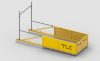

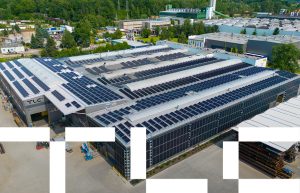


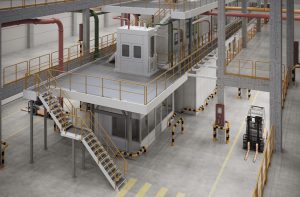
Construction site safety systems. Key rules you need to know
Why safety on a construction site is not an option, but an obligation
A construction site is no place for compromises. Even the best design, the fastest work pace and the most advanced equipment do not matter if people’s health or lives are at risk. In the construction industry, every neglect can cost more than just a delay – it can cost someone’s life.
Eurostat data for 2022 shows that in the European Union almost 3 million people were reported as injured in workplace accidents (resulting in at least 4 days of incapacity for work). This is an enormous number, and additionally 3,286 fatal accidents were recorded. The accident rate in the EU averages 1,506 incidents per 100,000 workers, and the fatality rate is 1.66 per 100,000 employees.
If we look only at the construction sector, the situation becomes even more serious: construction accounts for 22.9% of all fatal accidents in the EU, and the fatality rate here is as high as 6.1 per 100,000 workers, which is almost four times more than the average for the entire economy.
What are the most common causes of these accidents? Across Europe, the main causes are: loss of control over machinery, tools and transport equipment (20–27% of incidents), as well as slips, trips and falls (15–18%). In fatal accidents, collapses and material failures also play an important role (11.9%).
These figures show one thing – construction site safety systems and compliance with health and safety rules cannot be treated as an addition to the plan, but as its foundation. Work safety is not only a legal obligation, but above all real protection of workers’ lives and health.
Construction site safety systems – who can be held liable
On a construction site, there is no room for guessing who is responsible for what. The regulations clearly specify that construction site safety systems are not only the responsibility of one person, but the result of cooperation between several key roles.
In the European Union, the obligation to plan safety on a construction site follows from Council Directive 92/57/EEC on the minimum safety and health requirements for temporary or mobile construction sites. The directive obliges the client or developer to prepare a Safety and Health Plan (SHP) for projects that involve increased risk or engage a significant number of workers.
The employer bears full responsibility for ensuring safe and healthy working conditions in accordance with the Framework Directive 89/391/EEC, regardless of whether the duties have been assigned to specialised OHS services. The employer is responsible for ensuring adequate collective protection systems, equipping workers, organising training and instruction, implementing safety procedures and monitoring their observance.
The site manager, acting on behalf of the contractor, is obliged to organise and coordinate works in accordance with the requirements of Directive 92/57/EEC. This includes identifying and eliminating hazards, supervising the use of collective and personal protective measures, and ensuring that all processes comply with the design and safety standards.
Finally – the workers. According to Article 13 of the Framework Directive 89/391/EEC, they are obliged – within their possibilities – to take care of their own safety and that of other persons. This means an obligation to use the protective equipment provided, to follow OHS procedures and to report any hazards and irregularities.
Collective protection systems and safety rules on the construction site
What collective protection systems are and when they should be used
On every construction site there is one rule – first secure the site, then secure the people. This is why collective protection systems (CPS) have absolute priority over personal protection. According to European Union regulations – mainly the Framework Directive 89/391/EEC and Directive 92/57/EEC on minimum requirements for temporary or mobile construction sites – collective protection systems mean all technical solutions that protect a group of workers against occupational risk.
On a construction site we therefore use:
– scaffolding and working platforms with guardrails and toe boards,
– protective guardrails around excavations and slab edges,
– safety nets under openings and workplaces at height,
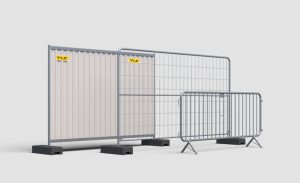
– Temporary fences and barriers, including SMART hoarding fences, MOBILT temporary fence panels and CITY barrier systems,
– Edge protection system (EPS),
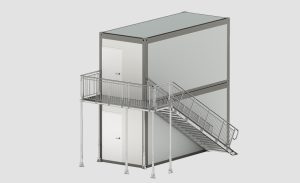
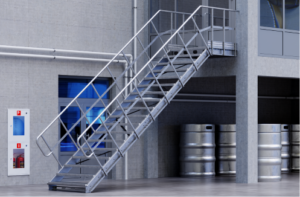
– Container stairs,
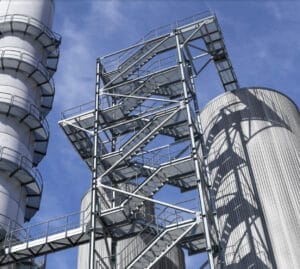
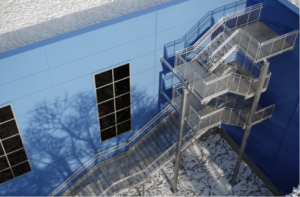
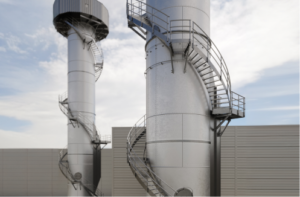
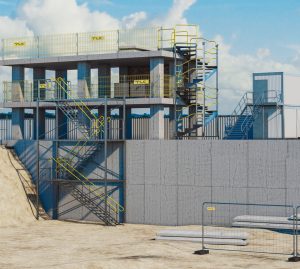
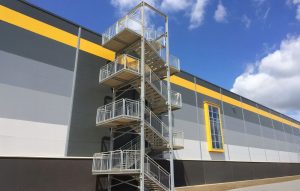
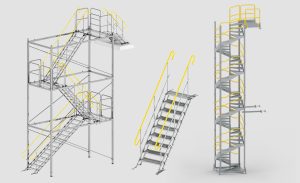
– Temporary stairs and staircases, including TAS temporary stairs and staircases as well as SST temporary spiral stairs,
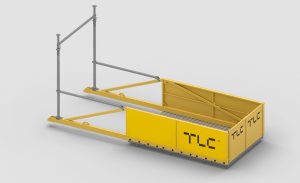
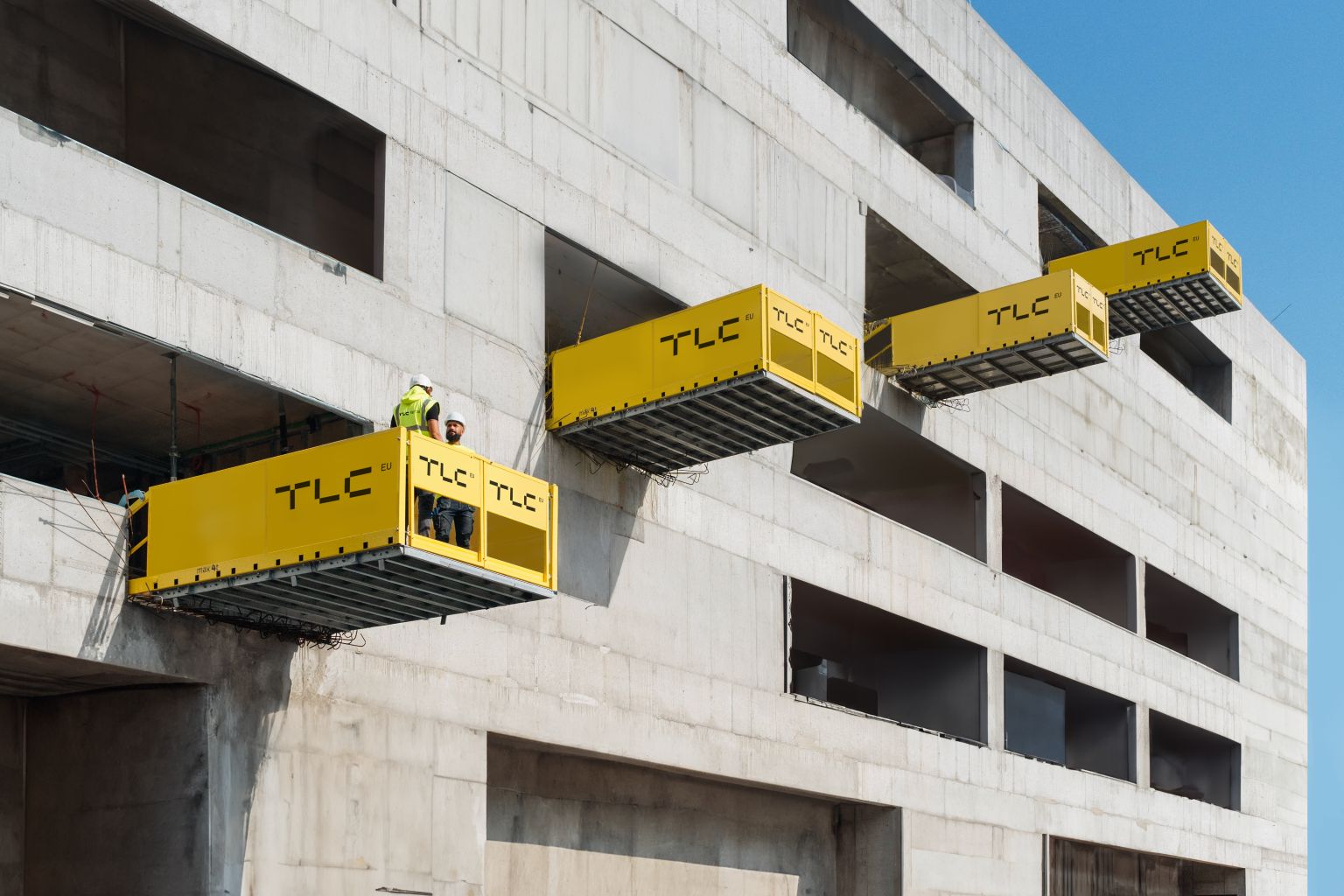
– Crane loading platform (TUP).
Protective devices that physically separate the worker from the hazard:
– guards on machines and equipment – e.g. on saws, conveyors or processing machines,
– barriers around hazardous zones – e.g. Smart solid fencing, CITY guardrails, MOBILT openwork fencing, temporary steel stairs TAS, temporary spiral stairs SST, temporary stair towers TAS, temporary aluminium stairs TAS,
– ventilation systems – which remove dust, gases and vapours, protecting the respiratory tract.
Technical measures – reacting before an accident occurs:
– alarms and signalling devices – acoustic, visual or combined,
– automation – that is robots and production lines that limit contact with hazards,
– protection against failures – for example monitoring systems and safety valves.
Organisational protective measures – order and readiness for evacuation:
– emergency procedures – what to do when something goes wrong,
– evacuation plans – with designated routes and persons responsible for coordination, checking zones, opening exits and controlling the headcount,
– OHS training – because an aware worker is a safe worker.
And what about noise? It can also be a collective hazard. Here the following help:
– acoustic insulation and sound-absorbing cabins,
– quieter machines and noise suppressors,
– sound-absorbing floor coverings and panels,
– division of space into quiet and noisy zones,
– rotational organisation of work and education on hearing protection.
Behind every helmet, guardrail and sign there is real life – occupational safety and health on a construction site is not about procedures, it is about caring for people.
PPE in practice – examples of personal protective equipment in the workplace

Not every hole can be fenced off, not every area can be secured with a net. And this is exactly when personal protective equipment comes into play – helmets, gloves, harnesses, goggles and all the other items we wear on ourselves. According to the Regulation on general OHS provisions, the employer is obliged to provide appropriate PPE to all persons present on the construction site – not only employees, but also service technicians, subcontractors and even inspectors.
The basic PPE set on a construction site includes:
– safety helmet – protects against impact and falling objects,
– safety footwear – with protective toecap, anti-electrostatic, puncture-resistant and slip-resistant sole,
– gloves adapted to the type of work such as cutting, assembly work and material handling,
– face and eye protection – used in the case of mechanical hazards related to particles, for example during grinding or cutting, as well as chemical hazards or radiation, for example during welding,
– hearing protection – protective earplugs and earmuffs,
– coveralls, jackets, trousers and protectors – used depending on weather conditions, contact with water, chemicals, heat or cold,
– fall protection system – anchorage subsystem, connecting and shock-absorbing subsystem, and a safety harness.
Does it work? And can we be sure it will not fail? Technical inspections on the construction site
Under European law, the site manager or the person appointed to coordinate OHS on the construction site is responsible for the technical condition of temporary safety systems. According to Directive 92/57/EEC on the minimum safety and health requirements for temporary or mobile construction sites, they are obliged to organise and supervise work in a way that ensures workers’ safety. This means, among others, regular inspections of collective protection systems: guardrails, nets, fencing and protective canopies. If the site manager does not carry out these inspections personally, they must appoint a responsible person and ensure that they are competent.
There is no top-down standard specifying how many hours apart guardrails, fencing and edge protection systems must be inspected; however, a simple rule applies – they must be checked daily, after every structural change and after extreme weather conditions, such as strong wind. All these inspections should be recorded in the site logbook – not only in order to meet formal requirements, but above all so that in case of an incident it is possible to clearly determine whether the human factor or a technical factor failed.
Even with excellent equipment and an experienced team, neglecting issues related to occupational safety and health on a construction site can jeopardise the implementation of the entire project.
Construction sites protection – how to build safer, smarter and without unnecessary costs
Safety systems are often one of the key elements of a well-organised construction site. At a time when workplace safety, compliance with legal standards and effective budget management are just as important as construction technology itself, choosing the right temporary safety systems becomes a real answer to the needs of investors, contractors and site managers.
TLC operates exactly in this area – it offers solutions that help secure the construction site and protect people with no compromise on quality, compliance or efficiency. Its offer includes Temporary fences and barriers, Edge protection system (EPS), Container stairs, Crane loading platform (TUP), and Temporary stairs and staircases. What matters is not only the equipment itself, but also the comprehensive support provided by the company: technical consulting, transport, assembly and disassembly support, as well as compliance of all solutions with applicable safety standards such as EN 13374:2013.
Purchasing safety systems – an investment that pays off faster than you think
For larger investments or for companies that regularly carry out construction works, purchasing dedicated safety systems is a long-term saving. Having your own guardrails, stairs, fencing or loading platforms means independence from equipment availability, full control over schedules and the ability to react quickly to the needs of the construction site.
Investors and contractors who decide to purchase gain not only in financial terms. Having proven, standard-compliant systems also means better work planning, faster inspections and less stress during OHS audits. Site managers can plan all safety systems in advance, without worrying about logistics or stock shortages.
Take care of the safety of your construction site today. Contact our team to select the optimal systems for your project and improve safety, organisation and efficiency on site.
Read our other news
TLC ranks first among companies from Gorlice in the Brylanty Polskiej Gospodarki 2025 ranking

Meet TLC at POWTECH TECHNOPHARM 2026-Nuremberg, 29 September-1 October

TLC EU at Eurosatory 2026 in Paris – summary of our participation in the Polish National Pavilion
